History & Culture
From the first reports of the mineral springs through the flowering of the spa town to inscription on the UNESCO list. Discover the history of Mariánské Lázně (Marienbad).
From the springs to a spa town
The mineral springs around today's Mariánské Lázně (Marienbad) had been known for centuries to the canons of the nearby Premonstratensian monastery of Teplá, founded in 1193 by the nobleman Hroznata. The Cross Spring is first mentioned in the monastery annals in 1749 as a "salty acidulous water"; the same year a wooden cross was erected beside it, from which it took its name. At the close of the 18th century the monastery physician Josef Jan Nehr took up the systematic study of the springs, and in 1805–1807 he built the first brick house for spa guests by the Cross Spring. His work helped persuade the Teplá monastery to begin developing the site for spa guests.
The place has borne the name Mariánské Lázně since 1808. In 1812, by decision of Abbot Karl Kaspar Reitenberger, it became an independent municipality, and on 6 November 1818 Mariánské Lázně was declared a public spa. It became a town on 29 May 1865 by decision of Emperor Franz Joseph I, and received its coat of arms on 1 June 1866. In the course of the 19th century the settlement by the springs thus grew into a town of spa houses, hotels, colonnades and extensive parks.
The flowering of the 19th century
The new spa quickly won an international reputation. Guests came for the drinking cure, the baths and the social life. After the founding neoclassical phase of 1817–1823 came the town's golden age of 1870–1914, when a large part of the buildings that define the town to this day were built: the Church of the Assumption of the Virgin Mary (1844–1848), the Casino assembly rooms (1867), the Municipal Theatre (1868), the Main Colonnade (1888–1889), Nové Lázně (1896) and the hotels along Hlavní třída. The railway connected the town with Cheb, Plzeň, Prague and Vienna in 1872.
The town attracted monarchs, artists, scientists and politicians. Goethe visited Mariánské Lázně three times between 1820 and 1823, Chopin came in 1836, Mark Twain in the summer of 1891, and the British King Edward VII came nine times between 1897 and 1909. In his presence, on 21 August 1905, the course of the golf club founded in 1904 was ceremonially opened. More detailed stories are on the Famous Visitors page.

A town of parks and colonnades
The shape of the spa centre was determined not only by buildings. From 1817 the landscape gardener Václav Skalník began transforming the damp valley into an open park. Promenades linked the hotels with the springs and created a setting in which treatment was naturally complemented by walking and time spent outdoors.
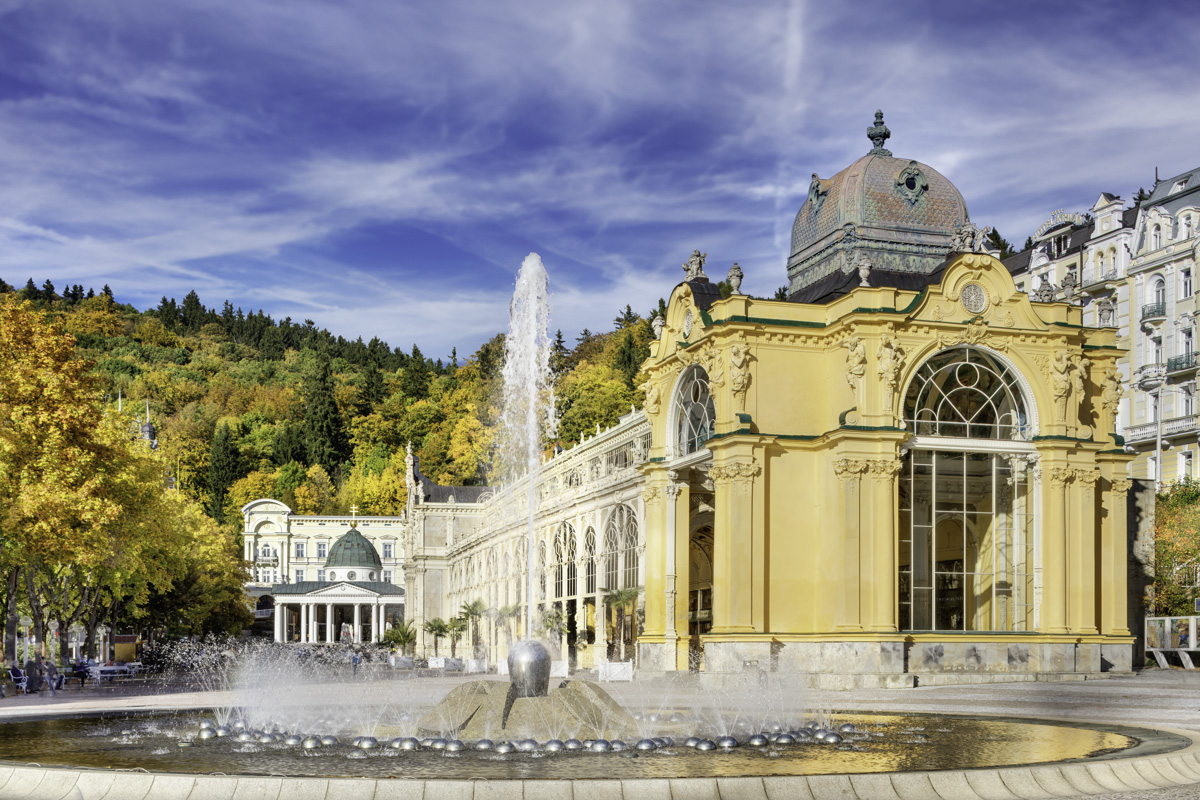
The Main Colonnade of 1888–1889, 135 metres long, became the town's best-known symbol. Nearby stands the Cross Spring pavilion of 1818–1826, and in front of the colonnade the Singing Fountain has played since 1986.

Mariánské Lázně in the 20th century
In the 1920s and 1930s spa life continued; guests included T. G. Masaryk and Edvard Beneš. Both world wars interrupted international spa operations, and during the Second World War Mariánské Lázně was a hospital town. Post-war changes in population and in the ownership of the spa houses transformed the character of the town; spa care focused chiefly on patients of the Czechoslovak health service.
After 1989 the restoration of the historic buildings began, along with the gradual return of foreign guests. Throughout, the town has remained a living spa centre, not merely a historic monument.
UNESCO and the present
In July 2021 Mariánské Lázně, together with ten other European towns, was inscribed on the UNESCO World Heritage List as part of the property The Great Spa Towns of Europe. The inscription honours the interplay of springs, spa architecture, parks and traditions that shaped European spa culture.

In 2023 the healing climate of Mariánské Lázně was officially confirmed, and the town uses the designation of a climatic spa. Alongside the mineral springs, spring gas and peat, all four of its natural healing resources are thus professionally confirmed.
What you can visit from its history
- The Municipal Museum is housed in the Golden Grape House of 1818, where Goethe stayed in 1823.
- The Main Colonnade recalls the town's flowering at the end of the 19th century.
- Nové Lázně of 1896 preserves the historic Roman Baths and the Royal Cabin.
- The Casino assembly rooms serve concerts, balls and social events.
- The Municipal Theatre offers a programme in its own historic building of 1868.
Related Articles
All Articles →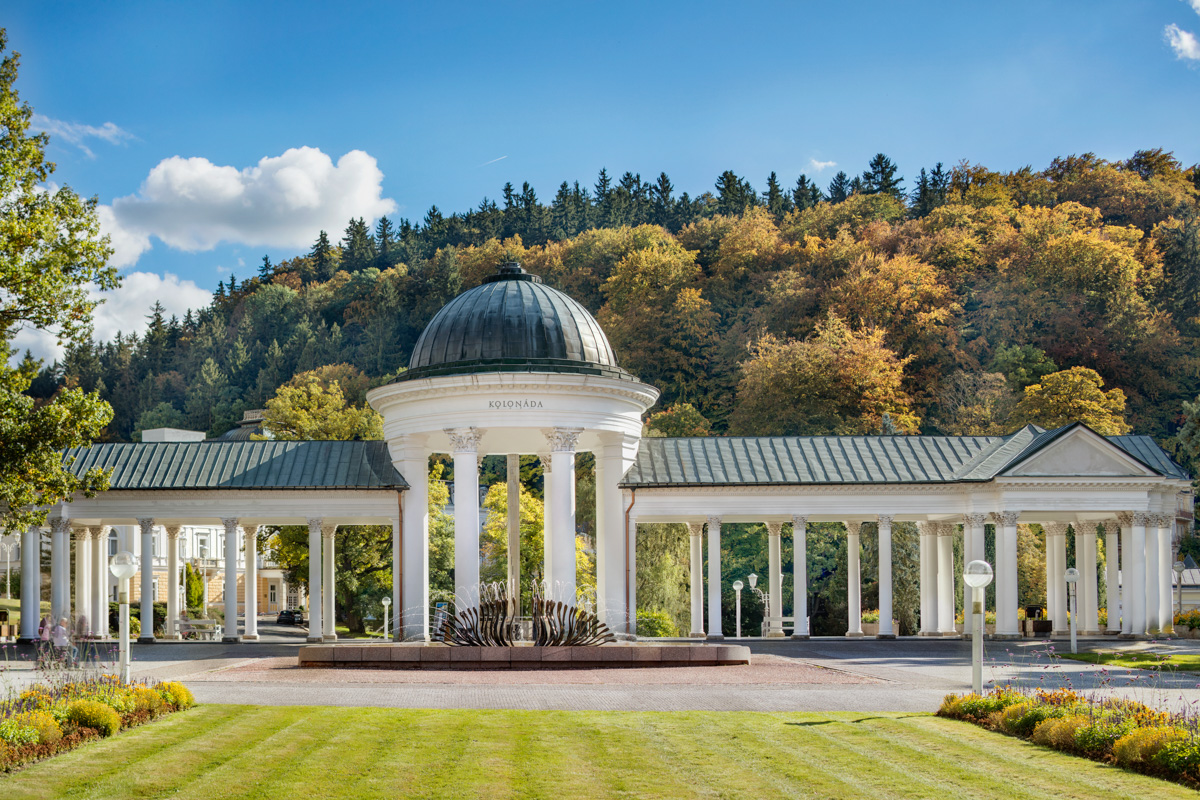
Alfred Nobel in Marienbad: a guest of 1893
HistoryThe Swedish chemist and inventor of dynamite, whose will gave the Nobel Prizes their name, stayed at the Hotel Casino in Ruská Street in 1893. What is known about his visit, what Marienbad looked like then and where to look for traces of that era today.
The first winter season of 1923/24: a bobsleigh run, a toboggan track and the Helmer ski jump
HistoryIn the winter of 1923/24 Marienbad set out to receive guests in the cold months for the first time. A winter sports club, a handful of hoteliers and an abbot gave the town a bobsleigh run, a toboggan track, a ski jump and natural ice. A look back at the season that brought winter to the spa town.
How the springs were captured: from timber casings to deep boreholes
HistoryAn apothecary's wooden cross, tin funnels, brick cones and boreholes a hundred metres deep: how Marienbad captured its springs over three centuries — from the Cross Spring and the Caroline Spring colonnade to the gas pool of the Maria Spring.